Technical SEO Audit Services
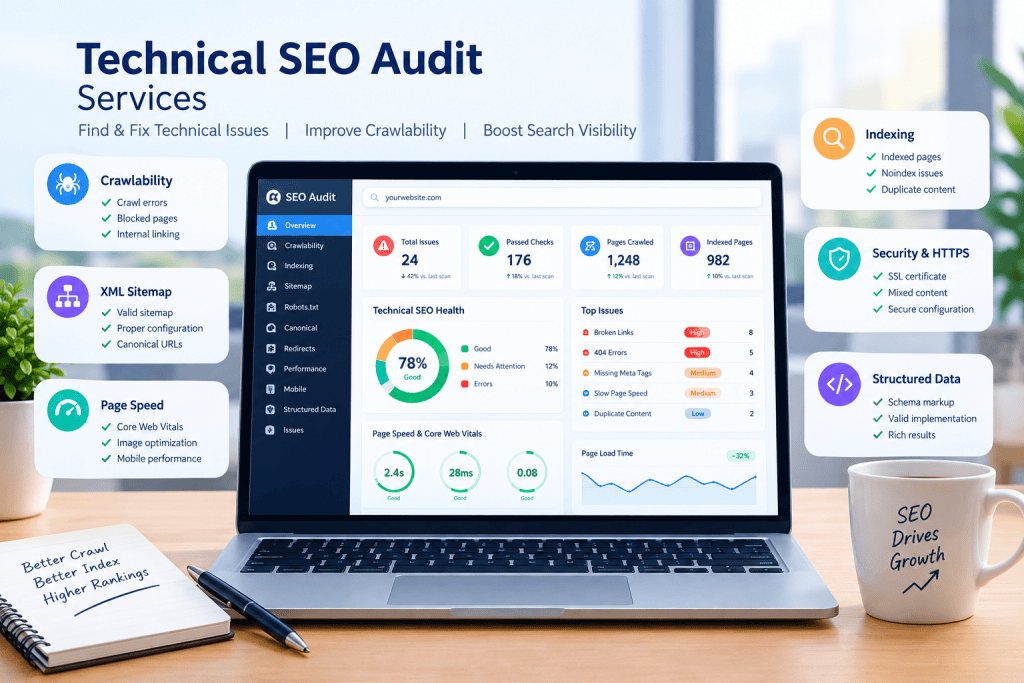
A technically healthy website gives search engines a clear path to crawl, understand, and index your pages. If important pages are blocked, duplicated, slow, poorly structured, or difficult to crawl, your website may not perform as well as it could in organic search.
Our Technical SEO Audit Services help identify technical problems that can affect crawling, indexing, website performance, user experience, and search visibility. We analyze your website, identify priority issues, and provide practical recommendations to improve its technical SEO foundation.
Table of Contents
What Is a Technical SEO Audit?
A technical SEO audit is a detailed examination of the technical elements that influence how search engines access, crawl, understand, and index a website.
Unlike content-focused SEO, technical SEO looks behind the visible content of your website. It examines areas such as crawlability, indexing, redirects, XML sitemaps, robots.txt, canonical URLs, structured data, page speed, mobile usability, and website architecture.
The goal is not simply to find as many issues as possible. A useful audit identifies the problems that matter, explains why they matter, and provides clear steps for resolving them.
What Our Technical SEO Audit Services Include
Our audit covers the core technical areas that can influence your website’s search performance.
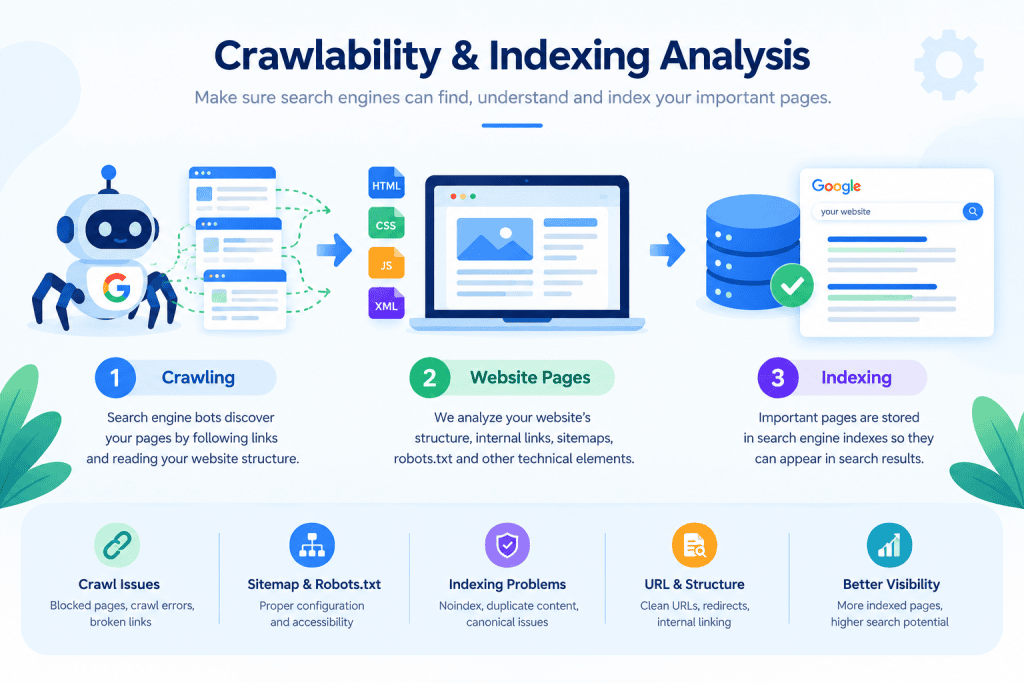
1. Crawlability Analysis
Search engines need to crawl your website before they can properly discover its pages.
We check for issues such as:
- Blocked pages
- Incorrect robots.txt directives
- Crawl errors
- Poor internal linking
- Broken links
- Unnecessary URL variations
- Crawl-related technical issues
The purpose is to make important pages accessible to search engine crawlers without creating unnecessary crawl paths.
2. Indexing Analysis
A page can exist on your website without being properly indexed by search engines.
We review potential indexing problems, including:
- Important pages that are not indexed
- Unwanted pages appearing in search results
- Incorrect noindex directives
- Duplicate or near-duplicate URLs
- Canonicalization problems
- Indexing inconsistencies
- Google-এর official technical requirements এবং SEO best practices সম্পর্কে জানতে [Google Search Essentials] দেখুন।
3. XML Sitemap Optimization
An XML sitemap helps search engines discover important URLs on your website.
We check whether your sitemap is:
- Available and accessible
- Properly configured
- Containing useful canonical URLs
- Free from unnecessary or problematic URLs
- Consistent with your website’s indexing strategy
For larger websites, sitemap structure and segmentation can also become important.
4. Robots.txt Analysis
The robots.txt file can control which areas of a website crawlers are allowed to access.
We check for incorrect or overly restrictive directives that could interfere with crawling.
We also look for situations where important resources or pages may unintentionally be restricted.
5. Canonical Tag Analysis
Canonical tags help search engines understand which version of a URL should be treated as the preferred version when multiple URLs contain similar or duplicate content.
We review:
- Missing canonical tags
- Incorrect canonical URLs
- Self-referencing canonicals
- Cross-domain canonicals where applicable
- Canonical conflicts
- URLs pointing to non-indexable canonical versions
Proper canonicalization can reduce confusion caused by duplicate URL variations.
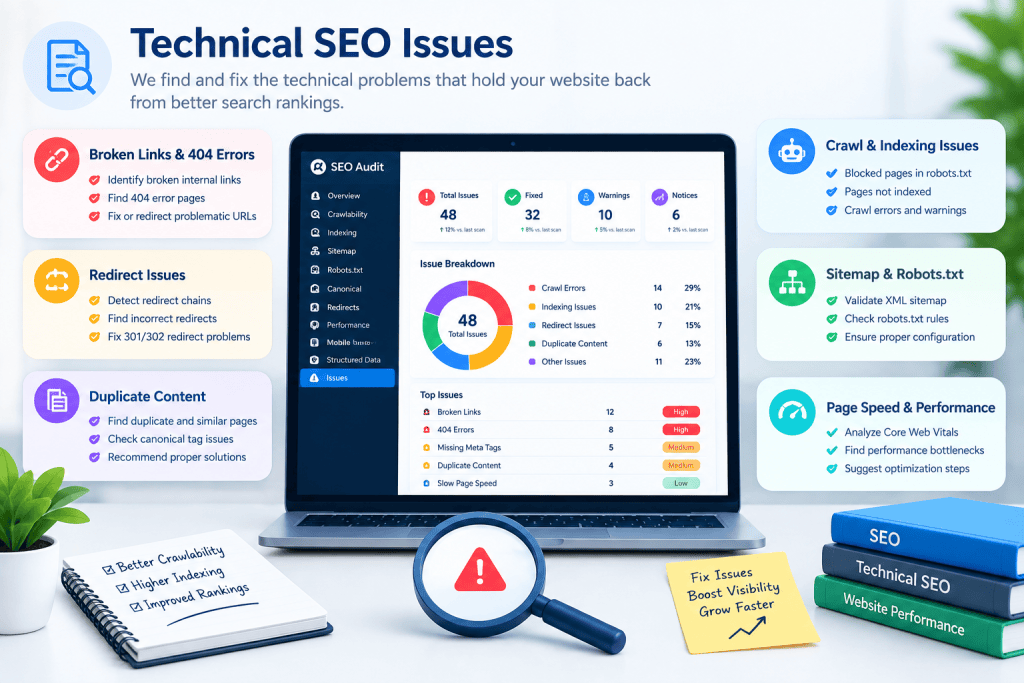
6. Broken Links and 404 Errors
Broken internal links create poor user experiences and can make website navigation less efficient.
During the audit, we identify:
- Broken internal links
- 404 pages
- Incorrect URLs
- Links pointing to redirected pages
- Potentially unnecessary redirect chains
Where appropriate, we recommend replacing, redirecting, or removing problematic links.
7. Redirect Analysis
Redirects are useful when URLs change, but incorrect implementation can create unnecessary problems.
We check for:
- Incorrect 301 redirects
- Unnecessary 302 redirects
- Redirect chains
- Redirect loops
- Redirects pointing to irrelevant destinations
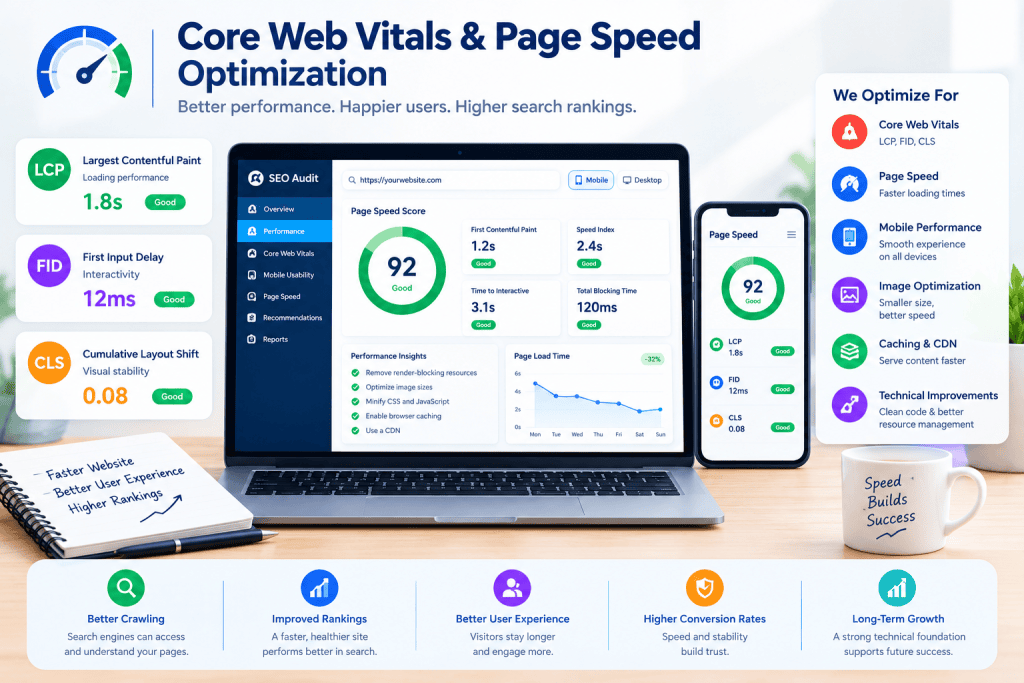
8. Page Speed and Core Web Vitals
Website performance affects both user experience and how efficiently a website can operate.
We review performance-related areas such as:
- Slow-loading pages
- Large images
- Excessive scripts
- Render-blocking resources
- Core Web Vitals
- Mobile performance
- Server response considerations
9. Mobile SEO
Search engines evaluate websites in a mobile-first environment, making mobile usability an important part of technical SEO.
We check for issues involving:
- Mobile usability
- Responsive layouts
- Content visibility
- Navigation
- Mobile page speed
- Viewport configuration
A technically sound website should provide a consistent experience across different screen sizes.
10. Structured Data and Schema Markup
Structured data helps search engines better understand certain types of content.
We review relevant schema implementation and look for:
- Missing structured data where appropriate
- Invalid markup
- Incorrect properties
- Implementation errors
- Conflicting structured data
Schema should be relevant to the content and implemented accurately rather than added simply for SEO purposes.
11. URL Structure
A clear URL structure makes website architecture easier for both users and search engines to understand.
We review:
- Long or unnecessarily complicated URLs
- Inconsistent URL structures
- Duplicate URL variations
- Unclear folder structures
- Parameter-related issues where relevant
The objective is to create a logical and maintainable website architecture.
12. Internal Linking and Site Architecture
Internal links help users and search engines discover related pages throughout a website.
We analyze:
- Important pages with insufficient internal links
- Orphan pages
- Weak navigation paths
- Deeply buried pages
- Opportunities for contextual internal linking
A strong internal linking structure can improve discoverability and help establish relationships between related pages.
13. Duplicate Content
Duplicate or highly similar pages can make it harder to determine which URL should be prioritized.
We investigate potential duplication caused by:
- URL variations
- Parameters
- Similar pages
- Duplicate metadata
- Multiple versions of the same content
Where appropriate, we recommend canonicalization, redirects, consolidation, or other suitable solutions.
14. HTTPS and Website Security
We check basic technical signals related to secure website access, including HTTPS implementation and potential mixed-content issues.
A secure and correctly configured website provides a better foundation for users and search engines.
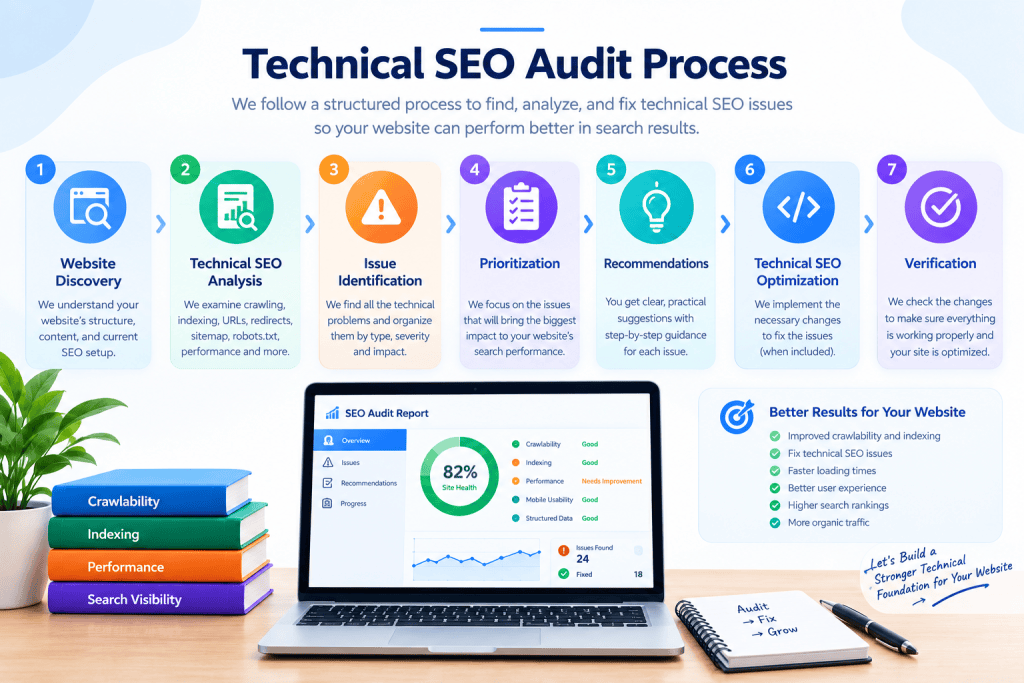
Our Technical SEO Audit Process
A successful audit is more than running a tool and exporting a report. We use a structured process to understand the website and prioritize its technical problems.
Step 1: Website Discovery
We first understand the website’s structure, content types, important pages, and overall SEO setup.
Step 2: Technical SEO Analysis
We analyze crawling, indexing, URLs, redirects, sitemap configuration, robots.txt, canonicalization, performance, structured data, and other relevant technical elements.
Step 3: Issue Identification
We organize the findings according to their type, importance, and potential impact.
Step 4: Prioritization
Not every technical issue requires immediate action. We prioritize issues based on factors such as their severity, affected pages, and relevance to the website’s goals.
Step 5: Recommendations
Each important issue is accompanied by a practical explanation of what needs to be changed and why.
Step 6: Technical SEO Optimization
Where the agreed service includes implementation, identified issues can be addressed through appropriate technical SEO changes.
Step 7: Verification
After implementation, important changes should be checked again to confirm that the intended fixes have been applied correctly.
Common Technical SEO Problems We Can Help Identify
Some websites have dozens or even hundreds of technical issues. Common examples include:
- Pages blocked from crawling
- Important pages not indexed
- Incorrect robots.txt rules
- XML sitemap errors
- Broken internal links
- 404 errors
- Redirect chains
- Incorrect canonical tags
- Duplicate URLs
- Orphan pages
- Slow-loading pages
- Mobile usability problems
- Missing or invalid structured data
- Poor internal linking
- Incorrect URL structures
- HTTPS or mixed-content issues
The exact problems vary from website to website, which is why a proper analysis should be based on the actual website rather than a generic checklist.
Who Can Benefit From a Technical SEO Audit?
A technical SEO audit can be useful for:
New Websites
New websites can use an audit to establish a clean technical foundation before investing heavily in content and link building.
Existing Websites
Established websites may accumulate technical problems over time as pages are added, deleted, redesigned, redirected, or migrated.
Website Redesigns
A redesign or migration can change URLs, navigation, internal links, metadata, and other technical elements. Reviewing these changes can help identify potential SEO problems.
E-commerce Websites
Large e-commerce websites often contain many URLs, filters, product variations, categories, and pagination patterns that require careful technical management.
Content Websites
Blogs and content-heavy websites can develop duplicate pages, orphan content, weak internal linking, and indexing problems as they grow.
1. What is a Technical SEO Audit?
A Technical SEO Audit is a detailed review of a website's technical elements that can affect crawling, indexing, performance, and search visibility. It can identify issues such as broken links, crawl errors, incorrect redirects, sitemap problems, canonical issues, slow page speed, and mobile usability problems.
2. Why does my website need a Technical SEO Audit?
A website can have technical problems that are difficult to identify from the front end. An audit helps uncover issues that may prevent search engines from efficiently crawling, understanding, or indexing important pages. Fixing relevant technical problems can provide a stronger foundation for your overall SEO strategy.
3. What does a Technical SEO Audit include?
A technical audit can include crawlability, indexing, XML sitemap, robots.txt, canonical tags, redirects, broken links, URL structure, internal linking, duplicate content, Core Web Vitals, mobile usability, HTTPS, and structured data. The exact areas reviewed depend on the website's size, structure, and technical setup.
4. How do you identify Technical SEO issues?
Technical SEO issues can be identified by analyzing the website's crawl data, indexing status, URL structure, internal links, redirects, sitemap, robots.txt, page performance, structured data, and other technical signals. The findings are then reviewed to determine which issues require attention.
5. Can you fix the technical SEO issues found during the audit?
Yes. Depending on the selected service, technical SEO implementation can be included after the audit. Recommendations may cover fixes for crawlability, indexing, redirects, broken links, sitemap configuration, canonical tags, performance, structured data, and other relevant issues.
6. Is a Technical SEO Audit useful for a new website?
Yes. A technical audit can help a new website establish a clean SEO foundation before it grows. Identifying problems with crawling, indexing, site structure, URLs, sitemap configuration, and performance early can make ongoing SEO management easier.
7. How often should I perform a Technical SEO Audit?
There is no single schedule that applies to every website. The frequency depends on factors such as website size, publishing activity, technical complexity, migrations, redesigns, and major changes. An additional audit can also be useful after significant technical changes or website migrations.
8. What will I receive after the Technical SEO Audit?
The deliverables depend on the selected service, but an audit can include a technical SEO analysis, identified issues, priority recommendations, explanations of the problems, and a practical action plan. If implementation is included, the relevant technical fixes can also be addressed and verified.
Why Technical SEO Matters
Technical SEO creates the foundation on which other SEO activities operate.
A detailed Technical SEO Audit Services process can help uncover technical barriers that are difficult to identify through basic on-page SEO checks.
You can publish high-quality content, build backlinks, and optimize keywords, but technical problems may still prevent search engines from efficiently discovering, crawling, or indexing important pages.
Technical optimization can help create a website that is:
- Easier for search engines to crawl
- Easier to understand and index
- More efficient for users to navigate
- More technically consistent
- Better prepared for ongoing SEO growth
Technical SEO is not about making arbitrary changes to a website. Every recommendation should have a clear technical reason and a relevant SEO purpose.
What You Receive From the Audit
Depending on the selected service, the audit can include:
- Technical SEO analysis
- Technical issue identification
- Crawlability review
- Indexing review
- Sitemap analysis
- Robots.txt analysis
- Canonical review
- Broken link analysis
- Redirect analysis
- Core Web Vitals review
- Mobile SEO review
- Structured data review
- Internal linking analysis
- URL structure review
- Prioritized recommendations
- Technical SEO action plan
The final recommendations should be based on the actual condition of your website rather than a one-size-fits-all checklist.
Ready to Improve Your Website’s Technical SEO?
If technical problems are limiting your website’s search visibility or making it difficult for search engines to properly access important pages, a detailed technical analysis can help you understand where the problems are.
Get a Technical SEO Audit Services assessment and identify the technical issues that deserve attention first.
If you prefer to order the service through Fiverr, you can view my Technical SEO Audit service on Fiverr.
Let’s analyze your website and build a clear technical SEO action plan.